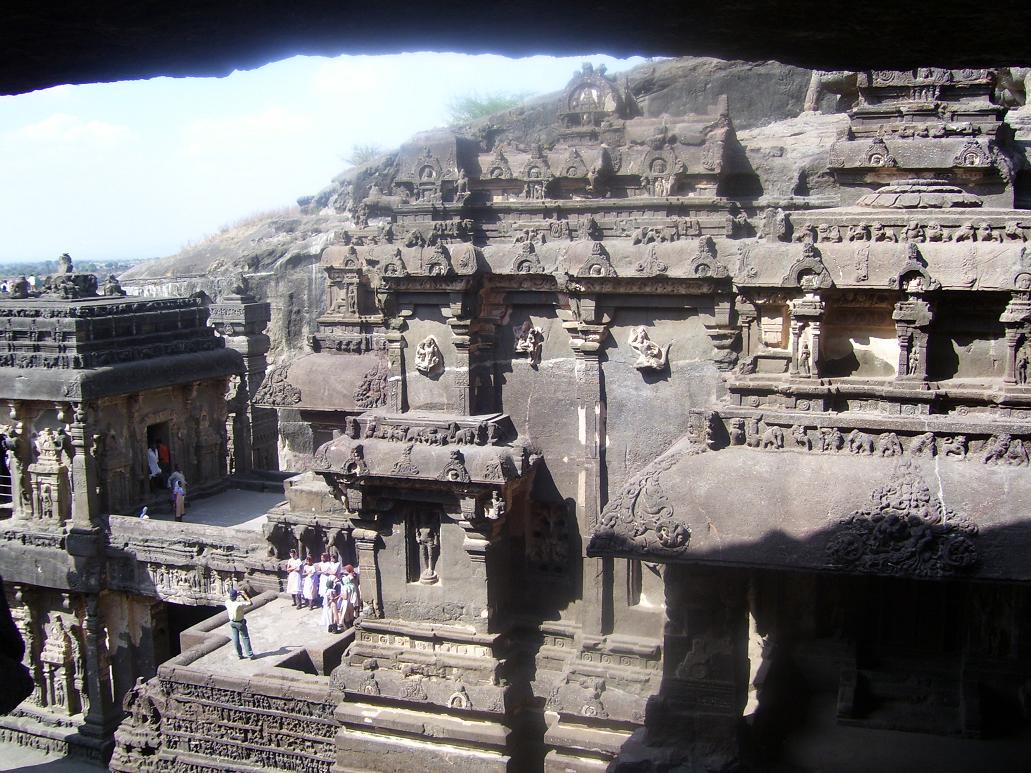
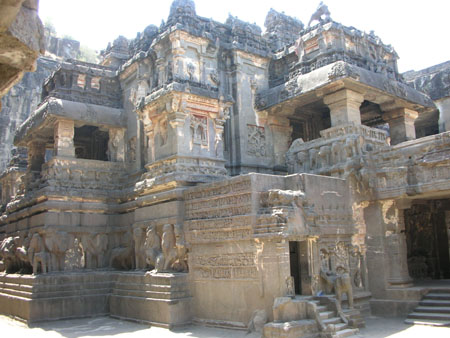
Ellora Caves ( TEMPLES OF MAHARASHTRA )


Maharashtra Tourism

Maharashtra Tourism Development Corporation (MTDC) has been established under the Companies Act, 1956, (fully owned by Govt. of Maharashtra) for systematic development of tourism on commercial lines, with an authorized share capital of Rs. 25 crore. The paid up share capital of the Corporation as on 31st March 2008 is Rs.15.38 lakhs. The Corporation receives from the State Government financial assistance in the form of share capital and grants. The State Government has entrusted all commercial and promotional tourism activities to this Corporation.
MTDC has, since its inception, been involved in the development and maintenance of the various tourist locations of Maharashtra. MTDC owns and maintains resorts at all key tourist centers and having more resorts is on the plan.

FOR MORE INFOR VIST :-- http://www.maharashtratourism.gov.in

BJP, Congress dial 108 to woo voters

Ahmedabad: When it is election time, political parties do not hesitate to take credit for the success of a project even if they have no hand in it. This is best exemplified by the game both the BJP and Congress are playing by telling people that the phenomenal success of EMRI (108) service is because of their initiatives.


Both the parties see huge potential in marketing the EMRI success mantra among voters. The idea is to give the voters an impression that the party that has brought the most-needed service to the doorstep of the common man believes in development agenda and that people should vote for that party.

During his recent election campaigns across Gujarat, chief minister Narendra Modi has said that it was his government that had started the service for people. He took a dig at the Congress party and UPA government for taking credit for the EMRI success.

"I've started the service and people of Gujarat are taking benefit of this. Even villagers of Maharashtra on Gujarat-Maharashtra border take help of the service - they bring patients to the nearby village of Gujarat and then use the '108' ambulance," Modi said in a recent public meeting.Modi blamed the state unit of the Congress for publishing advertisements in the local media to take credit for the service. "The Congress is giving advertisements to mislead people about the '108' ambulance service, which is purely the state government's initiative," Modi said in a recent public meeting.

The '108' service was launched in the state one-and-a-half years ago and now it is available in all districts with a fleet of around 400 ambulances. The prompt and efficient service provided by EMRI has made it hugely popular across the state. When the serial blasts rocked Ahmedabad in July last year, '108' was of tremendous help to victims.

According to the state government, the project is not run by the Central government. Says health minister and government spokesperson Jay Narayan Vyas: "The scheme has been initiated by the Modi government and it is run by the state government. It has nothing to do with the Centre as being claimed by the Congress.''

However, the Congress says the project is actually funded by the Central government.
"The state government answered to a RTI application that Rs69 crore was used from funds of Central government for running the '108' service,'' said Manish Doshi, Congress spokesperson. "The service has been started with funds allocated to the state government under National Rural Health Mission of the Union government,'' Doshi added.

Modi, Advani have lost mental balance: Maharashtra CM

Vadodara Lashing out at BJP’s prime ministerial candidate LK Advani and Chief Minister Narendra Modi, Maharashtra Chief Minister Ashok Chavan said on Monday that both of them had lost their mental balance. He said this when asked to comment on Manmohan Singh being termed as a weak prime minister.
Chavan said, “Those who call the PM weak seem to have lost their mental balance. The PM has shown his strength in the decisions he has taken. On the issue of nuclear deal, which was important for the development of the country, he exhibited his strong character by putting his foot down… to the extent of even showing willingness to sacrifice his government for the betterment of the country.”

On the much-debated ‘PM taking orders from Congress President Sonia Gandhi’, Chavan, who is campaigning for Congress candidate Bharatsinh Solanki in Anand, said, “We discuss our issues within the Congress party. Are we supposed to go to the RSS headquarters to discuss our issues?”

He also accused Modi of misleading the people of Gujarat and Maharashtra. “He is spreading lies such as farmers in Gujarat getting 24 hours electricity. Today, I met farmers here and discovered that often there is no power for 16 to 18 hours. He has been spreading lies in Maharashtra as well, but the voters know the truth. People are smart enough to realise what lies behind such claims,” said Chavan.

The Maha CM, who also visited Vadodara said, “He has done nothing earth-shattering. He is only good for receiving clapping. Under the Jawaharlal Nehru National Urban Renewal Mission (JNNURM) project, the UPA government gave the state Rs 750 crore, which the state government is yet to utilise.” He also took on Modi on the issue of corruption. “In Mahrashtra, he was talking about things such as corruption-free governance. Here, everyone knows about the level of corruption in the Sujalam Sufalam Yojana.”

He also said that a business magazine had recently elevated Maharastra to the status of a leading state followed by Tamil Nadu and Gujarat on number three.

“Gujarat is a part of India and we all want Gujarat to progress, but one person should not take the credit for this.”

Mumbai goes to vote in final phase April 30

About 13.9 million voters will exercise their franchise in 10 constituencies in Maharashtra in the third and final phase of the Lok Sabha polls on Thursday. Six of the 10 constituencies fall in Mumbai while the remaining four are in adjacent Thane district.

The Congress-Nationalist Congress Party (NCP) and the Shiv Sena-Bharatiya Janata Party (BJP) combines are locked in the main tussle in all the seats.

Raj Thackeray's Maharashtra Navnirman Sena (MNS) is trying to open an account in the state by contesting for nine seats (of the total 12 it is contesting).

In the fray for the 10 seats are 196 candidates, including 17 women.

The Congress is pitted against the BJP in four constituencies - Palghar, Bhiwandi, Mumbai North and Mumbai North-Central - and against the Shiv Sena in three - Mumbai South, Mumbai South-Central and Mumbai North-West.

The NCP will lock horns with the BJP in Mumbai North-East and against the Shiv Sena in two constituencies - Kalyan and Thane.

Contesting from one constituency each are the Samajwadi Party (Mumbai North-West), Lalu Prasad's Rashtriya Janata Dal (Mumbai South-Central), the Indian Union Muslim League (Palghar) and the Communist Party of India-Marxist (Kalyan).

Prominent contestants in the fray are sitting MPs Milind Deora and Priya Dutt (both Congress), state Congress general secretary Gurudas Kamat and former Shiv Sena MP and now Congress nominee Sanjay Nirupam.

The BJP has former union minister Ram Naik, prominent criminal lawyer Mahesh Jethmalani and former Mumbai party chief Kirit Somaiya while former state minister Gajanan Kirtikar and Five-time MP Mohan Rawale are the Shive Sena candidates.

The third phase will also decide the electoral fortunes of former state minister Bala Nandgaonkar (MNS) and Rajya Sabha MP Abu Asim Azmi (Samajwadi Party).

Professionals have also plunged into the poll arena this time with ABN Amro Bank's India head Meera H Sanyal, an independent candidate in Mumbai South, leading the pack.

The recently-launched Professionals Party of India (PPI) has put up Mona Shah, a surgeon, in Mumbai South, and Rajendra Thacker, a businessman, in Mumbai North.

The state has 48 Lok Sabha constituencies.

Mahindra-Renault looking at expanding beyond Logan

Renault and Indian auto major Mahindra and Mahindra, which jointly manufacture the sedan Logan in India, will expand their product portfolio to better utilise the capacity at their Nashik plant in Maharashtra.

"We are currently assessing the viability of four to five Renault cars to be manufactured in the facility and will finalise the models with Mahindra," Ashish Sinharoy, Renault India's senior vice president of corporate affairs, told IANS.

This comes as a U-turn for both car makers who had in the past ruled out expanding the product line-up in the joint venture in the short term.

The scope of the current joint venture does not go beyond manufacturing Logan and integrating the distribution and sales networks.

But two factors have worked towards the re-think: Logan's sales have plummeted, and the Nashik facility has been rendered under-utilised.

Sinharoy said Logan, which did very well in the first year of its launch, has been a victim of the economic slowdown. Coupled with this, there was a lack of options in terms of other models available in the joint venture's stable; hence the decision to expand, he said.

Mahindra-Renault managed to sell close to 26,000 units of Logan during the 11 months of 2007-08 since the car was launched, while the number nearly halved to only 13,423 last fiscal.

"As a result, the plant has been under-utilised and the dealer network is also under-selling. So we are actively looking at optimising the utilisation and have decided to introduce new models in our line-up," Sinharoy said.

"Although the numbers for the new vehicles won't be huge, it will definitely pep up the dealer network and induce demand."

Tata Motors launches new Starbus range of buses in Maharashtra

Tata group company, Tata Motors, today announced the launch of an all-new Starbus range of buses in Maharashtra.

The buses are being manufactured at the fully- automated Tata Marcopolo Motors Limited (TMML) plant which is a joint venture between Tata Motors and Marcopolo of Brazil, a press release issued here said.

The plant is located in Dharwad, Karnataka.

The Starbus will be sold to customers as fully-built buses and coaches, the release said.

These buses are ideal for all applications including transportation of school children, company staff, route bus and as a transport to route destinations.

Pawar maintains reconciliatory note

After weeks of trying to browbeat Congress, NCP chief Sharad Pawar stuck to the conciliatory note he had struck on Sunday, saying that
Left and Congress would be able to sink their differences in a post-poll scenario to thwart BJP from forming a government.

Speaking to a TV channel, Pawar kept away from the leadership issue though he did express his "gratitude" to AIADMK and BJD for considering him a prime ministerial candidate. He also did not move away from his view that the issue should be settled by consultation within UPA, but did not make his candidacy a sticking point.

He sought to position himself as a bridge between Congress and Left, saying that the heat of election resulted in posturing on both sides. "After the elections, when people assess the situation and realise the ground reality, they will show pragmatism," he said, adding he was confident Left will also take a fresh look at tying up with Congress.

"I am confident that Prakash Karat... I can understand his unhappiness towards Congress or me or towards anyone else, but after the elections I am absolutely clear about one thing -- the Left will not act in a fashion that there will be a BJP-led government," Pawar said. His suggestion that Left too can find itself under pressure is a shift from his alignment with efforts to question Congress's leadership claims.

Pawar is quite capable to moving back to a tougher anti-Congress line as the leader said that the bargaining power of parties will lie in the numbers they manage to win. His effort to shore up UPA could be rooted in the concern that an image of "disunity" has hurt the NCP-Congress alliance in the second round of polling on April 23 in 25 Maharashtra seats. Any post-poll gameplan could be jeopardised if NCP fails to put up a decent show in the first place.

He did not see the prime ministerial issue being particularly problematic, saying UPA leaders could resolve it in one sitting. On his own claims, he took a more pragmatic line, saying, "I have made my position clear a number of times. I am hardly contesting 42 seats. In this type of situation, the most important thing is numbers. I have not got this number... Unless you get substantive support from all major parties one should not expect this."

Pawar's remarks may also demonstrate that he is preparing for various possibilities after the elections. While not withdrawing his claim, he is looking at the possibility of Congress defeating the efforts of some of its allies and former partners to peg it back and still emerging with numbers to lead the next government. At the same time, he has not given up on trying to emerge as the senior partner in Maharashtra and enhance his bargaining position ahead of assembly elections due later this year.


DISTRICT GAZETTER DEPARMENT

Gazetteers Department is a separate Directorate of the Govt of Maharashtra under the administrative control of the Cultural Affairs Department of the Govt. of Maharashtra.This Department publishes District and State Gazetteers in Marathi and English Languages


Working of the Department
Information and Documents required for the Gazetteer volumes is collected from the relevant departments of Govt.from non-official agencies as also from responsible citizens by correspondence and conducting surveys. It is also collected from various secondary and primary sources,archives,publications,correspondence and individual visits.The collected information is collated and scrutinized for the drafts of the Gazetteers. Important topics like history,archaeology and geography are got written by the scholars. The Edited drafts are scrutinized by the Editorial Board Members and then corrected drafts are sent for final printing.


GAZETTEER DEPARTMENT

Our Publications

District Gazetteers (British Period)
Revised District Gazetteers (English)
District Gazetteers (Marathi)
State Gazetteers
Source Material for a History of the Freedom Movement in India


State Government Initiative

1. Gujarat Earthquake Rehabilitation Project (GERP)

2. Maharashtra Emergency Earthquake Rehabilitation

3. "Samruddhi" (A Vision of Rural Prosperity)

4. "SARAS- 2001" EMPOWERMENT THROUGH SELF EMPLOYMENT -A UNIQUE EXPERIENCE.

5. Water Conservation through Nagpuri Weirs

GOVERNMENT OF MAHARASHTRA Department Websites

Department Websites

Agriculture, Animal Husbandry, Dairy Development and Fisheries Department
Cooperation and Textile Department
Directorate Of Small Savings
Employment & Self Employment Department
Environment Department
Finance Department
Food, Civil Supplies & Consumer Protection Department
General Administration Department
Higher and Technical Education Department
Home Department
Housing Department
Industries, Energy and Labour Department
IT Department
Law and Judiciary Department
Maharashtra Public Service Commission
Medical Education and Drugs Department
Minorities Development Department
Parliamentary Affairs Department
Planning Department
Public Health Department
Public Works Department
Revenue & Forest Department
Rural Development Department
State Planning Board
School Education & Sports Department
Social Justice & Special Assistance Department
Tribal Development Department
Tourism & Cultural Affairs Department
Urban Development Department
Water Conservation Department
Water Resources Department
Water Supply and Sanitation Department
Women and Child Development Department

GOVERNMENT OF MAHARASHTRA

Government Of Maharashtra
Official Website


http://www.maharashtra.gov.in/

land of the Marathi

The word Maharashtra, the land of the Marathi speaking people, appears to be derived from Maharashtri, an old form of Prakrit. Some believe that the word indicates that it was the land of the Mahars and the Rattas, while others consider it to be a corruption of the term 'Maha Kantara' (the Great Forest), a synonym for 'Dandakaranya'.


THE LAND

Located in the north centre of Peninsular India, with a command of the Arabian Sea through its port of Mumbai, Maharashtra has a remarkable physical homogeneity, enforced by its underlying geology. The dominant physical trait of the state is its plateau character. The Maharashtra Desh is a plateau of plateaux, its western upturned rims rising to form the Sahyadri Range and its slopes gently descending towards the east and southeast. The major rivers and their master tributaries have carved the plateaux into alternating broad-river valleys and intervening higher lever interfluves, such as the Ahmednagar, Buldana, and Yavatmal plateaux.

The Sahyadri Range is the physical backbone of Maharashtra. Rising on an average to an elevation of 1000m. it falls in steep cliffs, to the Konkan on the west. Eastwards, the hill country falls in steps through a transitional area known as Mawal to the plateau level. The series of crowning plateaux on the crest forms a distinctive feature of the Sahyadri Range.

The Konkan, lying between the Arabian Sea and the Sahyadri Range is narrow coastal lowland, barely 50 km. wide. Though mostly below 200 m., it is far from being a plain country. Highly dissected and broken, the Konkan alternates between narrow, steep-sided valleys and low laterite plateaux.

The Satpudas, hills along the northern border, and the Bhamragad-Chiroli-Gaikhuri Ranges on the eastern border form physical barriers preventing easy movement, but also serve as natural limits to the state.


GEOLOGY
Except around Mumbai, and along the eastern limits, the State of Maharashtra presents a monotonously uniform, flat-topped skyline. This topography of the state is the outcome of its geological structure. The state area, barring the extreme eastern Vidarbha region, parts of Kolhapur and Sindhudurg, is practically co-terminous with the Deccan Traps. Roughly 60 to 90 million years ago, the outpouring of basic lava through fissures formed horizontally bedded basalt over large areas. Variations in their composition and structure have resulted in massive, well-jointed steel-grey cliff faces alternating with structural benches of vesicular amygdaloid lava and ash layers, all of which contribute to the pyramida-shaped hills and crest-level plateaux or mesas. Earth sculpturing under the tropical climate completed the panorama-sharply defining the landform features in the semi-arid conditions, and rounding the hilltops under wetter condition. Fluvial action by the Krishna, Bhima, Godavari, Tapi-Purna and Wardha-Wainganga river systems has further aided in the compartmentalisation of the Desh into broad, open river valleys, alternating with plateau interfluves, that form the ribs of the Sahyadrian backbone. In sharp contrast, the hill torrents of the Konkan, barely a 100 km. long, tumble down as roaring streams which flow in deeply entrenched valleys to terminate in tidal estuaries.


CLIMATE

The state enjoys a tropical monsoon climate; the hot scorching summer from March onwards yields to the rainy monsoon in early June. The rich green cover of the monsoon season persists during the mild winter that follows through an unpleasant October transition, but turns into a dusty, barren brown as the summer sets in again. The seasonal rains from the western sea-clouds are very heavy and the rainfall is over 400 cm., on the Sahyadrian crests. The Konkan on the windward side is also endowed with heavy rainfall, declining northwards. East of the Sahyadri, the rainfall diminishes to a meagre 70 cm. in the western plateau districts, with Solapur-Ahmednagar lying in the heart of the dry zone. The rains increase slightly, later in the season, eastwards in the Marathwada and Vidarbha regions.

The highly pulsatory character of the monsoon, with its short spells of rainy weather and long dry breaks, floods, as well as droughts add much to the discomfort of the rural economy.


RESORSE
Forests comprising only 17% of the state area cover the eastern region and the Sahyadri Range, while open scrub jungle dots the plateaux. If Maharashtra represented the Maha Kantara in the historic past, today little of it is left; vast sections have been denuded and stripped of the vegetal cover.

The soils of Maharashtra are residual, derived from the underlying basalts. In the semi-dry plateau, the regur (black-cotton soil) is clayey, rich in iron, but poor in nitrogen and organic matter; it is moisture-retentive. Where redeposited along the river valleys, those kali soils are deeper and heavier, better suited for rabi crops. Farther away, with a better mixture of lime, the morand soils form the ideal Kharif zone. The higher plateau areas have pather soils, which contain more gravel. In the rainy Konkan, and the Sahyadri Range, the same basalts give rise to the brick-red laterites productive under a forest-cover, but readily stripped into a sterile varkas when the vegetation is removed. By and large, soils of Maharashtra are shallow and somewhat poor.

Water is the most precious natural resource of the state, greatly in the demand, and most unevenly distributed. A large number of villages lack drinking water, especially during the summer months, even in the wet Konkan. Barely 11% of the net sown area is irrigated. Perched water tables in the basalt aquifers have contributed to increased well irrigation, which accounts for approximately 55% of the irrigable water. The granitic-gneissic terrain in the eastern hilly area of Vidarbha accounts for all tank irrigation. Tube-wells in the Tapi-Purna alluvium and shallow wells in the coastal sands are the other main sources of water.

The mineral-bearing zones of Maharashtra lie beyond the area of the basalts in eastern Vidarbha, southern Kolhapur and the Sindhudurg area. The Chandrapur, Gadchirali, Bhandara and Nagpur Districts form the main mineral belt, with coal and manganese as the major minerals and iron ore and limestone as potential wealth. The Ratnagiri coast contains sizeable deposits of illimenite.

About Maharashtra


Maharashtra is a state located on the western coast of India. Maharashtra is a part of Western India. It is India's third largest state by area and second largest by population.

Maharashtra is bordered by the Arabian Sea to the west, Gujarat and the Union territory of Dadra and Nagar Haveli to the northwest, Madhya Pradesh to the northeast, Chhattisgarh to the east, Karnataka to the south, Andhra Pradesh to the southeast, and Goa to the southwest. The state covers an area of 307,731 km2 (118,816 sq mi) or 9.84% of the total geographical area of India. Mumbai, the capital city of the state, is India's largest city and the financial capital of the nation. Marathi is the official and most widely spoken language.

In the 17th Century, the Marathas rose under the leadership of Chhatrapati Shivaji against the Mughals who were ruling a large part of India. After the third Anglo-Maratha war, the empire ended and most of Maharashtra became part of Bombay state under a British Raj. After Indian independence, Maharashtra Samyukta Maharashtra Samiti demanded unification of all Marathi speaking regions under one state. The first state reorganization committee created the current Maharashtra state on May 1, 1960 (known as Maharashtra Day). The Marathi-speaking areas of Bombay state, Deccan states and Vidarbha (which was part of Central Provinces and Berar) united to form the current state.